In mid-October 2025, at the invitation of Indonesian medical experts, Professor Wenlin Wang traveled to Makassar and Bali to conduct surgical demonstrations and participate in academic exchanges. During the visit, he presented the techniques and principles of the ICWS team, providing more doctors with opportunities to learn about innovative chest wall surgical methods, and offering local patients a wider range of safe and effective treatment options.
Successful Complex Chest Wall Deformity Surgery in Indonesia
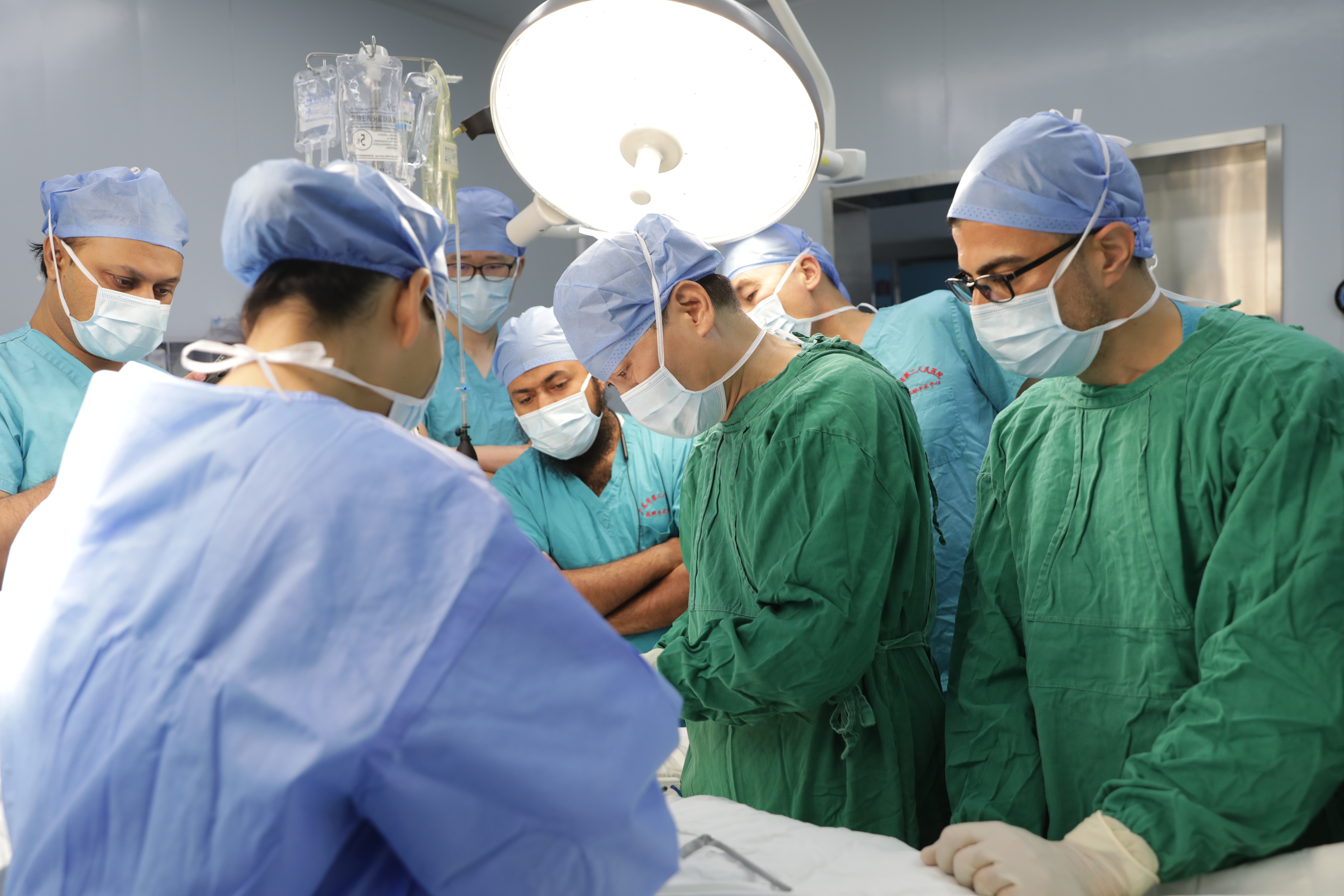
On October 16, 2025, Professor Wenlin Wang performed a challenging surgery for a 12-year-old girl with a severe chest wall deformity in Makassar, Indonesia. Her chest wall had a distinct depression, resembling a small tilted bowl. Even light activities caused her to feel breathless and her heart rate to spike, and the inability to lie flat for extended periods severely disrupted her sleep and daily life. Examinations revealed that the patient's heart rate while lying flat reached as high as 180 beats per minute—nearly double that of a normal child (70–90 bpm)—making surgical correction of the deformity urgently necessary.
During the operation, Professor Wang implanted three bars. He first performed the Wung procedure to correct the depression, then carried out the Wenlin procedure to address the local protrusion that had formed during the correction of the depression, ensuring a smoother chest wall contour that could closely conform to the steel bars.
One of the greatest challenges in this case was that the girl’s heart rate would increase sharply whenever she lay flat for too long, meaning the entire operation had to be accomplished within a strictly limited timeframe to minimize the risk of cardiac arrest. Moreover, every incision required extreme precision, as even a slight deviation could damage the heart or major blood vessels. Fortunately, through close collaboration and highly efficient coordination between Professor Wang and the local surgical team, the procedure was completed successfully in just one hour. After surgery, the child’s sunken chest was fully corrected, the chest returned to a natural contour, and both respiratory function and cardiac compression were significantly relieved.
Learn more about this case: Minimally Invasive Surgery for Malignant Pectus Excavatum
Currently, we are working to establish long-term cooperation with the hospital on patient referral and physician training, to expand access to care for more local patients with chest wall deformities in the near future.

Severe asymmetric depression deformity

Medical specialists from several Indonesian hospitals came to observe the operation.

A post-surgery photo taken with several local experts
Ideas in Dialogue: Academic Exchanges in Indonesia
On October 16, 2025, Professor Wenlin Wang was invited to deliver a special lecture at Hasanuddin University in Indonesia, titled“Surgical Strategies for Complex Chest Wall Deformities.”
During the lecture, Professor Wang systematically reviewed the ICWS team’s achievements in chest wall deformity correction, introducing a surgical philosophy and technical system distinct from mainstream international paradigms. The lecture attracted widespread attention and prompted lively discussion. Professor Muhammad Nuralim Mallapasi, a 74-year-old pioneer of thoracic surgery in Indonesia, attended the entire lecture and engaged in in-depth discussions with Professor Wang on related topics.

Professor Wenlin Wang together with Professor Muhammad Nuralim Mallapasi
On October 20, at Udayana University in Bali, another focused academic session was held. Professor Wang provided a detailed overview of the latest techniques and future directions in chest wall surgery. The report was divided into two parts: chest wall correction surgeries, which addressed various complex deformities, and chest wall reconstruction surgeries, primarily aimed at treating chest wall defect and other related conditions.
This trip to Indonesia provided local doctors with a firsthand understanding of the ICWS team's surgical approach and philosophy, while the lectures and exchanges enhanced the connection between doctors from the two countries. Looking ahead, this experience and collaboration are expected to extend to more hospitals, enabling more patients with chest wall deformities to receive safe and reliable surgical care.

Professor Wenlin Wang at Hasanuddin University
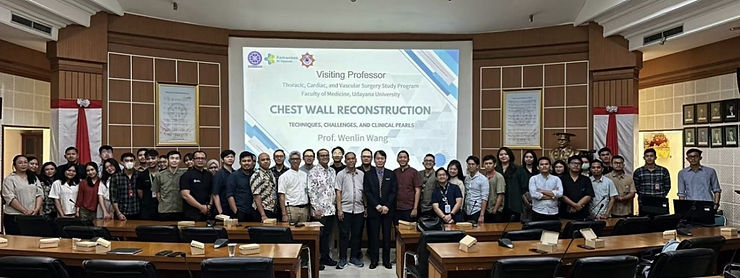
Professor Wenlin Wang at Udayana University

Professor Wenlin Wang at Udayana University

Professor Wenlin Wang delivered a lecture at Udayana University
.png)
.png)