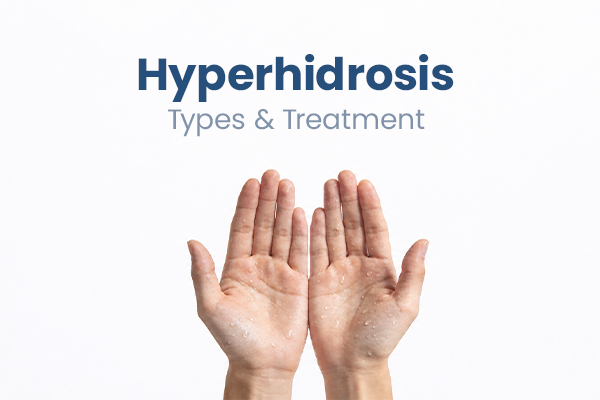

Excessive sweating on the hands is not always normal. When sweating is frequent, visible, and out of proportion to heat or exercise, it may be palmar hyperhidrosis, a medical condition that can be treated and often controlled.
Palmar hyperhidrosis affects quality of life because it can interfere with handshakes, writing, device use, and work tasks. It is not dangerous in itself, but it is often persistent and distressing.
Normal Sweating Hands vs. Palmar Hyperhidrosis
Why do people sweat?
Sweating is a normal thermoregulatory response that helps keep body temperature stable when you are exposed to heat, exercise, or emotional stress. Eccrine sweat glands, which are dense on the palms, soles, and underarms, receive signals from the sympathetic nervous system and release an odorless, watery fluid that cools the skin as it evaporates.
What is hyperhidrosis? What is palmar hyperhidrosis?
Hyperhidrosis is defined as excessive sweating beyond the thermoregulatory needs, often occurring at rest, in cool environments, or out of proportion to emotional triggers.
Primary focal hyperhidrosis refers to localized, bilateral excessive sweating(asymmetric in rare cases) not caused by other diseases or drugs, and palmar hyperhidrosis is the subtype that mainly affects the palms and fingers.
Clinically, palmar hyperhidrosis presents primarily as excessive sweating of the palms. In primary focal hyperhidrosis, isolated palmar involvement is uncommon. It often accompanies plantar (soles) or axillary (underarms) hyperhidrosis. The main combinations are palms + soles, palms + axillae, or palms + soles + axillae.
(Craniofacial hyperhidrosis is rare in primary cases and is not typically a primary associated type with palmar hyperhidrosis.)
Learn more about the pathogenesis and types of hyperhidrosis: What is Hyperhidrosis? Exploring Its Types and Treatment Options
Normal Sweating vs. Palmar Hyperhidrosis at A Glance
|
Feature |
Normal sweating |
Hyperhidrosis |
|
Cause |
- (not a disease) |
Primary: Exact cause unclear, but is generally thought to be linked to genetic factors or sympathetic nervous system dysfunction Secondary: Often caused by neurological disorders, endocrine diseases, or other systemic conditions |
|
Trigger |
Heat, exercise, stress |
Often occurs spontaneously; can be worsened by heat and stress |
|
Pattern |
Temporary and proportional |
Recurrent, visible, and excessive |
|
Location |
Can happen anywhere |
Mainly palms; often with feet or underarms |
|
Night sweating |
Usually absent |
People with primary hyperhidrosis usually do not sweat excessively while sleeping. Persistent night sweats are a warning sign and warrant a thorough evaluation for underlying conditions, such as infections (e.g., tuberculosis) and malignancies (e.g., lymphoma). |
|
Daily impact |
Limited |
Can affect school, work, social contact, and hand use |
How Common is Hyperhidrosis/Palmar Hyperhidrosis?
In the past, epidemiologic data on palmar hyperhidrosis were limited.
However, more studies have been published in recent years, and some of them provide useful statistical findings:
- Archives of Dermatological Research (2016) [1]: Reported that the prevalence of hyperhidrosis in the United States is 4.8%, affecting approximately 15.3 million people. The study also found that prevalence is highest among individuals aged 18–39 (8.8%), and lowest among children and adolescents (2.1%).
- Dermatology (2016) [2]: Found that the prevalence of primary hyperhidrosis is 5.5%, with severe primary hyperhidrosis (HDSS score 3–4) at 1.4%. The prevalence of secondary hyperhidrosis was reported to be 14.8%.
- Eur J Cardiothorac Surg (2007) [3]: Reported an incidence rate of palmar hyperhidrosis of 4.59%, with severe cases accounting for 0.12%.
- Clin Auton Res(2014) [4]: Reported a prevalence rate of palmar hyperhidrosis of 2.08%, including 1.94% in males and 2.29% in females; 2.81% in coastal regions and 1.53% in inland areas; with a family history observed in 25.4% of cases.
For many patients, symptoms begin in childhood or adolescence (typically between the ages of 8 and 12) and tend to worsen during puberty due to hormonal and emotional triggers.
Many studies suggest that palmar hyperhidrosis may also have a genetic tendency, with an autosomal dominant inheritance pattern[5]. In a Japanese population study, a specific chromosomal locus (14q11.2–q13) was confirmed to be associated with palmar hyperhidrosis[6].
Both males and females are affected; however, clinical data may show a higher proportion of female patients, possibly because women are more likely to seek medical treatment[7].
Palmar hyperhidrosis often occurs with hyperhidrosis of the feet or armpits, reflecting the high density of eccrine sweat glands in these areas. Although many patients are otherwise healthy, many report that hyperhidrosis has a major impact on school performance, career choices, and social activities.
Can Palmar Hyperhidrosis be Prevented?
Primary palmar hyperhidrosis cannot be prevented. Current evidence suggests a genetic or inherited tendency, so prevention is limited. If sweating is secondary to another disease or medication, treating the cause can reduce symptoms.
How is Palmar Hyperhidrosis Diagnosed?
Diagnosis of palmar hyperhidrosis is primarily clinical.
A clinician takes a detailed history and examines the skin to confirm focal, visible, excessive sweating that fits standard criteria. Widely used criteria require at least six months of excessive sweating without apparent cause plus two or more of the following features[8,9]:
1. Bilateral and symmetrical sweat on the palms
2. At least one episode per week
3. Onset before age 25
4. Impairment in daily activities
5. Positive family history
6. Absence of sweating during sleep
To grade severity, many clinicians use the Hyperhidrosis Disease Severity Scale (HDSS).
Tests such as the iodine–starch (Minor) test or paper gravimetry are sometimes added. The starch–iodine test highlights hyperhidrotic areas as dark blue patches, while paper tests quantify sweat output by weight[9,10]. Routine blood tests or imaging are reserved for suspected secondary causes such as endocrine, neurologic, or infectious disease.
How is Palmar Hyperhidrosis Treated?
Currently, multiple treatment options are available to effectively manage or treat palmar hyperhidrosis. Treatment selection should consider the underlying cause, affected areas, and severity of the condition, with an individualized approach recommended.
Non-surgical Treatments
Conservative treatment is the first choice for most patients, and consistent use can significantly reduce palmar sweating.
Some commonly used management options include:
-
Astringent solutions (antiperspirants)
-
Anticholinergic drugs
-
Iontophoresis
-
Botulinum toxin
-
Psychotherapy
- Emerging therapies (e.g., fractional radiofrequency with microneedles, microwave therapy, high intensity focused ultrasound)
Surgical Treatments
When other treatments are ineffective and symptoms persist, surgical intervention may provide long-lasting results.
Endoscopic thoracic sympathectomy (ETS) is currently the most effective treatment for palmar hyperhidrosis, with reported success rates ranging from 92% to 100%[11]. This palmar hyperhidrosis surgery achieves its effect by interrupting the sympathetic nerve pathways that control sweat glands in the hands.
However, it may lead to compensatory sweating in areas such as the abdomen, lower back, groin, and thighs.
Explore more hyperhidrosis treatment options, as well as their effectiveness: Can Hyperhidrosis be Cured?
When Should You See a Doctor?
If sweaty hands interfere with daily life, work, or social activities, you should consult a doctor promptly.
ICWS specializes in precise, minimally invasive T4 sympathectomy , with an effectiveness rate of 95%–100% and a low incidence of compensatory sweating. Experienced thoracic surgeons perform the procedure through a 5 mm incision in the axillary region on the affected side. In most cases, no drainage tube is required after surgery, and many patients can be discharged on the same day.
You are welcome to consult our specialists for further evaluation. ICWS Consultation.
References:
[1] Doolittle, J., Walker, P., Mills, T. et al. Hyperhidrosis: an update on prevalence and severity in the United States. Arch Dermatol Res 308, 743–749 (2016). https://doi.org/10.1007/s00403-016-1697-9
[2] Shayesteh, A., Janlert, U., Brulin, C., Boman, J., & Nylander, E. (2016). Prevalence and Characteristics of Hyperhidrosis in Sweden: A Cross-Sectional Study in the General Population. Dermatology (Basel, Switzerland), 232(5), 586–591. https://doi.org/10.1159/000448032
[3] Tu, Y. R., Li, X., Lin, M., Lai, F. C., Li, Y. P., Chen, J. F., & Ye, J. G. (2007). Epidemiological survey of primary palmar hyperhidrosis in adolescent in Fuzhou of People's Republic of China. European journal of cardio-thoracic surgery : official journal of the European Association for Cardio-thoracic Surgery, 31(4), 737–739. https://doi.org/10.1016/j.ejcts.2007.01.020
[4] Lai, FC., Tu, YR., Li, YP. et al. Nation wide epidemiological survey of primary palmar hyperhidrosis in the People’s Republic of China. Clin Auton Res 25, 105–108 (2015). https://doi.org/10.1007/s10286-014-0259-5
[5]Ro, K. M., Cantor, R. M., Lange, K. L., & Ahn, S. S. (2002). Palmar hyperhidrosis: evidence of genetic transmission. Journal of Vascular Surgery, 35(2), 382–386. https://doi.org/10.1067/mva.2002.119507
[6] Higashimoto, I., Yoshiura, K., Hirakawa, N., Higashimoto, K., Soejima, H., Totoki, T., Mukai, T., & Niikawa, N. (2006). Primary palmar hyperhidrosis locus maps to 14q11.2‐q13. American Journal of Medical Genetics Part A, 140A(6), 567–572. https://doi.org/10.1002/ajmg.a.31127
[7] Romero, F. R., Haddad, G. R., Miot, H. A., & Cataneo, D. C. (2016). Palmar hyperhidrosis: clinical, pathophysiological, diagnostic and therapeutic aspects. Anais Brasileiros De Dermatologia, 91(6), 716–725. https://doi.org/10.1590/abd1806-4841.20165358
[8] Haider, A. (2005). Focal hyperhidrosis: diagnosis and management. Canadian Medical Association Journal, 172(1), 69–75. https://doi.org/10.1503/cmaj.1040708
[9] Solish, M. J., Savinova, I., & Weinberg, M. J. (2022). A practical approach to the diagnosis and treatment of palmar hyperhidrosis. Plastic & Reconstructive Surgery Global Open, 10(3), e4172. https://doi.org/10.1097/gox.0000000000004172
[10] User, S. (2001, April 14). Diagnosis guidelines. International Hyperhidrosis Society | Official Site. https://www.sweathelp.org/about-hyperhidrosis/diagnosis-guidelines.html
[11] Gregoriou, S., Sidiropoulou, P., Kontochristopoulos, G., & Rigopoulos, D. (2019). Management Strategies Of Palmar Hyperhidrosis: Challenges And Solutions. Clinical, cosmetic and investigational dermatology, 12, 733–744. https://doi.org/10.2147/CCID.S210973
.png)
.png)