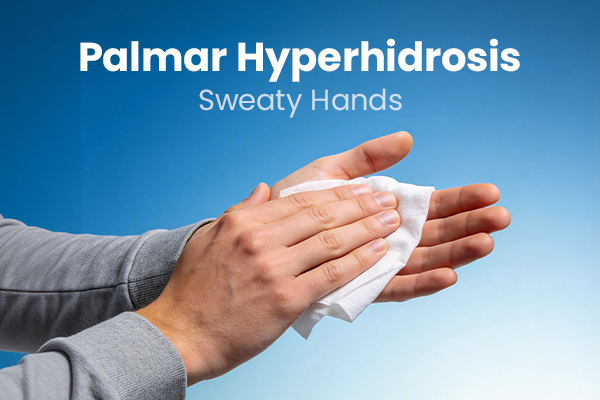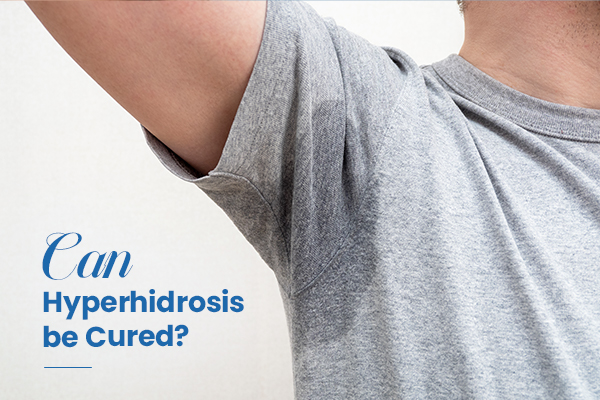

Do you experience intermittent hand sweating, sweaty feet in winter, or underarm sweating during colder months? If excessive sweating has seriously affected your daily life, you may have hyperhidrosis. This is a sweat gland disorder in which patients produce excessive sweat beyond what is required for normal body temperature regulation.
Continue reading to learn more professional knowledge about hyperhidrosis.
What is Hyperhidrosis?
Hyperhidrosis is a disorder of the sweat glands characterized by excessive sweating beyond the body’s thermoregulatory needs.
The human body contains approximately 2-4 million sweat glands. These glands are mainly divided into two types:
-
Eccrine sweat glands: Distributed throughout the body, they secrete sweat to regulate body temperature.
-
Apocrine sweat glands: Mainly located in hair follicles, they are the primary source of body odor.
Most sweat glands are eccrine sweat glands, densely distributed on the palms (hands), soles (feet), underarms, and face. Therefore, sweating in hyperhidrosis commonly occurs in these areas where eccrine glands are concentrated, especially the palms.
Epidemiological studies show that hyperhidrosis is common among adolescents and young adults. It typically begins between the ages of 8 and 12, and symptoms are most prominent before the age of 30. However, a small number of patients may experience symptoms throughout their lifetime.
This disproportionate sweating imposes psychological and economic burdens on patients. Patients report significant impairments in quality of life, affecting learning, daily activities, work, and social interactions.
Types of Hyperhidrosis
Hyperhidrosis can be classified into two primary categories that guide diagnosis and treatment decisions: primary (idiopathic) hyperhidrosis and secondary hyperhidrosis.
Primary (Idiopathic) Hyperhidrosis vs. Secondary Hyperhidrosis
-
Primary hyperhidrosis: The exact cause remains unclear. It is generally believed to be associated with sympathetic nervous system dysfunction or genetic factors.
Reports indicate that the global prevalence of primary hyperhidrosis ranges from 0.072% to 9%[1], accounting for 93% of all hyperhidrosis cases[1,2].
Primary Palmar Hyperhidrosis is one localized manifestation of primary hyperhidrosis.
-
Secondary hyperhidrosis: Caused by medications, underlying diseases, or other systemic factors (e.g., anxiety disorders, hyperthyroidism, diabetes, and pulmonary tuberculosis).
Focal Hyperhidrosis vs. Generalized Hyperhidrosis
Hyperhidrosis can also be further divided into focal hyperhidrosis and generalized hyperhidrosis.
-
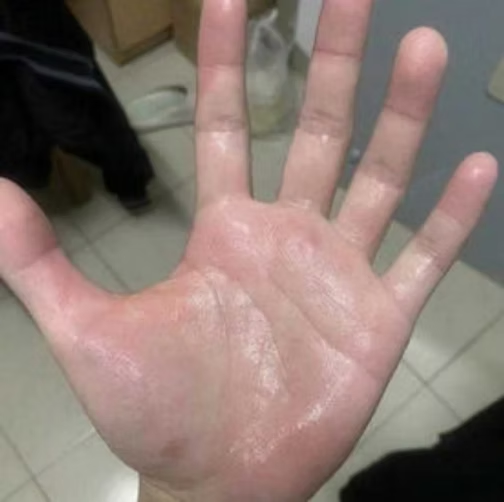
Focal hyperhidrosis: Commonly affects sweat gland-dense areas such as the palms, soles, underarms, face, and chest. It usually appears symmetrically on both sides of the body (though asymmetry can occur in rare cases). The skin may appear soaked and pale. Sweating can be intermittent or continuous, often more pronounced with emotional stress, and typically shows no obvious seasonal pattern.
The vast majority of primary hyperhidrosis cases manifest as focal hyperhidrosis, most commonly involving the palms, soles, and underarms.
-
Generalized hyperhidrosis: Rare, affecting most or all of the body skin. It is primarily caused by other conditions, such as generalized sweating due to infectious fevers, endocrine disorders, hormonal imbalances, central nervous system lesions, and more.
Hyperhidrosis ICD-10 Codes ((Professional Extension):
-
In the WHO ICD-10 international standard, R61 is used for the broad classification of hyperhidrosis.
-
The United States ICD-10-CM system provides more detailed subcodes, for example: L74.510 (Primary focal hyperhidrosis, axilla), L74.511 (Primary focal hyperhidrosis, face), L74.512 (Primary focal hyperhidrosis, palms), L74.513(Primary focal hyperhidrosis, soles) L74.519 (Primary focal hyperhidrosis, unspecified), L74.52 (Secondary focal hyperhidrosis), and R61 for Generalized hyperhidrosis.
Symptoms of Hyperhidrosis
The primary symptom of hyperhidrosis is abnormally excessive sweating, manifesting as visible sweat beads or droplets. It occurs regardless of the season or temperature, exceeding the amount needed for body temperature regulation.
The most common sweating areas are the palms, soles, underarms, face, trunk, and genital region.
Some patients may also experience clamminess, eczema, cyanosis, or desquamation of the palms.
Common patient complaints include:
-
Dripping or soaked skin on the hands, feet, underarms, or face
-
Frequent clothing soaking or damp shoes
-
Long-term moisture causing skin maceration, whitening, or cracking
-
Persistent dampness leading to secondary skin infections
-
Multiple studies indicate that severe hyperhidrosis can significantly affect quality of life and may even lead to mental health issues. Patients often experience anxiety, depression, social withdrawal, and limitations in career development.
Diagnosis Methods of Hyperhidrosis
A detailed medical history and physical examination are usually sufficient to make a clear diagnosis. Assessment typically includes evaluating the affected areas, the duration and frequency of sweating, and the family history of sweating.
For patients suspected of having underlying conditions, further examinations may be performed to identify the cause, such as chest CT scans, thyroid function tests, complete blood counts, urinalysis, stool analysis, and blood biochemical tests.
Treatment Options for Hyperhidrosis
Conservative Treatments
1. Topical antiperspirants: e.g., aluminum chloride preparations.
2. Oral/systemic medications: e.g., oral anticholinergic medications, other systemic drugs.
3. Botulinum toxin A (BTX-A) injections: commonly used for palmar hyperhidrosis, plantar hyperhidrosis, and axillary hyperhidrosis.
4. Physical therapies (device-based): e.g., Iontophoresis, Microwave thermolysis, Ultrasound, Fractional Microneedle Radiofrequency, Laser treatments.
Surgical Treatments
Patients unresponsive to conservative treatments and strongly desiring surgery may consider hyperhidrosis surgery.
Currently, the most effective thoracic surgical method for hyperhidrosis is Endoscopic Thoracic Sympathectomy (ETS). With the assistance of thoracoscopy, ETS selectively transects, resects, ablates, or clips the sympathetic nerve chain at T2-T4 levels, achieving control rates of 95%-100%. However, some patients may experience compensatory sweating in other areas of the body.
For more detailed information on treatment options, see: Can Hyperhidrosis be Cured?

ICWS’ T4 Sympathectomy for Hyperhidrosis
Renowned Attending Physician: Dr. Weiguang Long
At ICWS, T4 sympathectomy is performed in a minimally invasive manner by experienced thoracic surgeons, achieving high efficacy while minimizing side effects. T4 sympathectomy involves dissecting the sympathetic nerve chain along the surface of the 3rd or 4th rib. It is considered an effective treatment option for hyperhidrosis.
A 5 mm incision is made in the axilla on the affected side. No drainage tube is required after surgery, allowing for faster recovery, and the vast majority of patients can be discharged on the same day.
Currently, ICWS’s ultra-minimally invasive T3-T4 sympathectomy has an effectiveness rate of up to 95%–100%. In addition, the incidence of compensatory sweating is relatively low, with symptoms typically being mild.
References:
[1] Maazi, M., Leung, A. K., & Lam, J. M. (2025). Primary hyperhidrosis: an updated review. Drugs in context, 14, 2025-3-2. https://doi.org/10.7573/dic.2025-3-2
[2] Nawrocki, S., & Cha, J. (2019). The etiology, diagnosis, and management of hyperhidrosis: A comprehensive review. Journal of the American Academy of Dermatology, 81(3), 657–666. https://doi.org/10.1016/j.jaad.2018.12.071
.png)
.png)