Pectus excavatum in adults does not always cause health problems. This congenital deformity causes the middle and lower sternum and adjacent costal cartilages to curve inward and is present from early life. Some adults seek care for pectus excavatum problems later in life, when new or worsening symptoms affect exercise or daily activities. This article explains why symptoms may develop or become more noticeable in adulthood, how adults are evaluated, and when treatment may be considered.
Why Can Pectus Excavatum Cause Problems Later in Life?
Pectus excavatum commonly becomes more noticeable while the chest is growing, particularly during rapid adolescent growth. The depression may deepen or widen as the ribs and costal cartilages develop.
As the chest wall matures, its bones and cartilages become less flexible. As a result, a deformity that caused little difficulty earlier in life may begin to affect physical function more noticeably. Symptoms such as reduced exercise tolerance, fatigue, shortness of breath, or palpitations may emerge after years with few or no limitations. Greater rigidity can also make corrective treatment more technically demanding in adults.[1]
So, Does Pectus Excavatum Get Worse With Age?
Not for everyone, and not always in the same way. Pectus excavatum does not resolve on its own, but structural progression is usually most evident during growth. After skeletal maturity, the visible chest shape may remain relatively stable or change more slowly, while symptoms can emerge or become more noticeable without a dramatic external change.
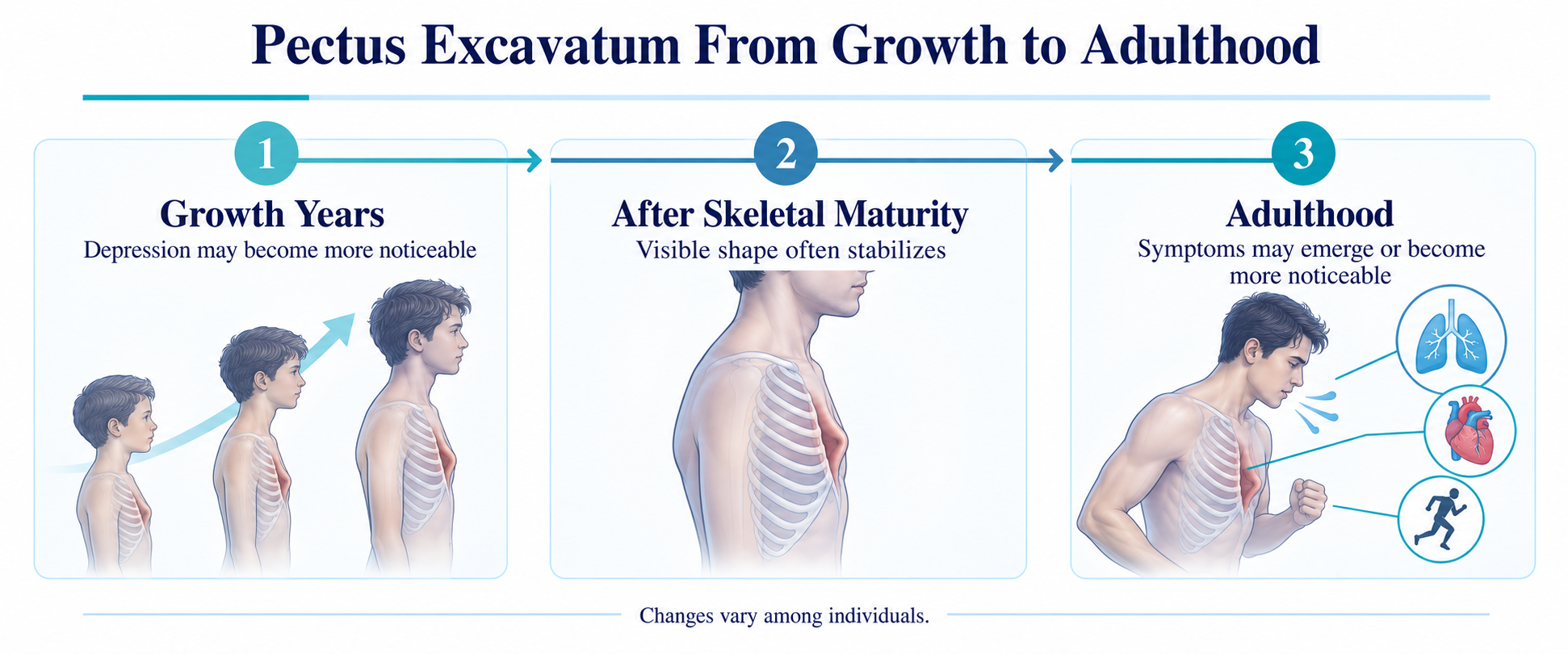
The impact of pectus excavatum in adulthood varies from person to person. It depends on factors such as the location and severity of the chest depression, its effects on the heart and lungs, chest wall flexibility, and the individual’s overall health and activity levels. Appearance alone does not tell the whole story. Changes in exercise tolerance and difficulty keeping up with everyday activities are also worth paying attention to. If you find yourself getting tired more easily during exercise or struggling more with daily activities than before, it’s worth discussing these changes with your doctor.
Which Changes Should Adults With Pectus Excavatum Watch For?
The key is to notice any changes from what is normal for you. Adults with pectus excavatum should compare their current stamina, breathing, and chest sensations with what they could do comfortably in the past. Changes that deserve attention include:
- Reduced exercise tolerance or stamina. A pace, distance, or workout that was previously comfortable may become difficult to maintain.
- Increasing fatigue during physical activity. Tiring much earlier than before, or needing longer to recover after routine exercise, can indicate a meaningful decline in functional capacity.
- Shortness of breath during exertion. Breathlessness that begins sooner, becomes more pronounced, or appears during ordinary activity should not automatically be attributed to age or fitness.
- Chest discomfort or pain. New, persistent, or activity-related discomfort needs assessment because chest wall, cardiac, respiratory, and musculoskeletal conditions can produce similar sensations.
- Palpitations or an unusually rapid heartbeat. Pay attention to recurrent episodes of a pounding or racing heartbeat, or the sensation of skipped beats, particularly during activity. Note when they occur and any possible triggers.
- Greater difficulty with ordinary activities. New limitations during walking, climbing stairs, or carrying everyday items may indicate a change in functional capacity.[2]
These pectus excavatum symptoms do not prove heart or lung compression on their own, and they do not establish a need for surgery. Because cardiac, respiratory, and systemic conditions can cause the same complaints, specialist evaluation is needed to determine whether the chest wall deformity is contributing.[1,2]
How Is Pectus Excavatum Evaluated in Adults?
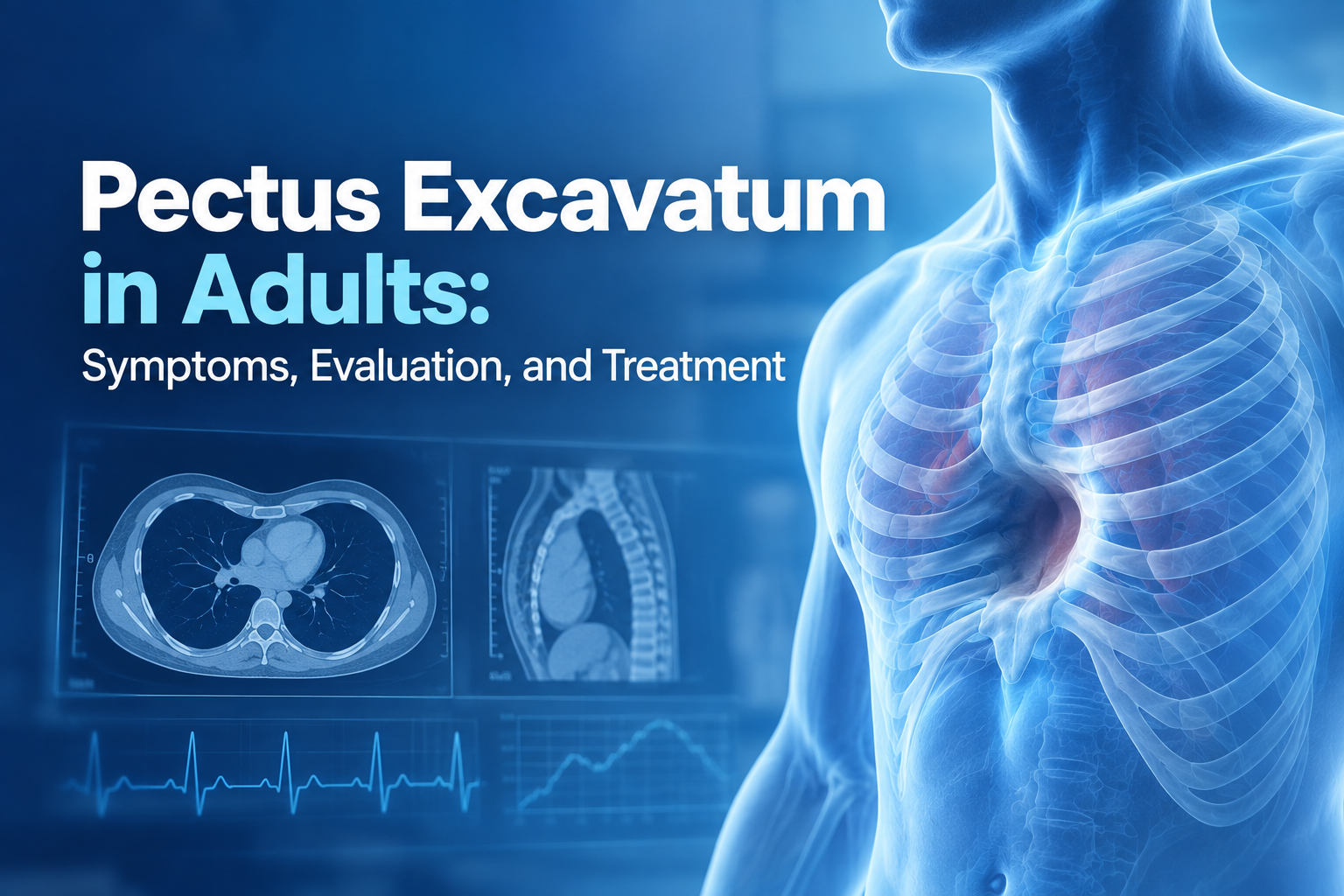
The evaluation of pectus excavatum in adults considers symptoms, chest anatomy and heart and lung function.
Start With the Symptom Pattern and Medical History
The clinical assessment establishes what has changed and which factors could be contributing:
- Symptoms and function: when symptoms began, whether they are progressing, how they relate to activity or body position, and whether exercise tolerance or the ability to manage everyday activities has declined.
- Chest wall findings: the depression's pattern and symmetry, together with any reported changes in appearance.
- Medical context: previous chest or cardiac surgery and relevant cardiac, respiratory, connective-tissue, or other medical conditions.
Computed tomography (CT) or magnetic resonance imaging (MRI) can define the depth, extent, and shape of the depression and show how the sternum relates to the heart and lungs. This internal view matters because two people with similar-looking chests may differ in how much the heart is displaced or compressed and how much space is available inside the chest.
Assess the Heart When Symptoms or Compression Raise Concern
Palpitations, chest discomfort, suspected compression, or associated heart disease may prompt an electrocardiogram (ECG) and, when appropriate, echocardiography. An ECG assesses heart rhythm, while echocardiography evaluates chamber and valve structure and pumping function. These tests can also help identify cardiac causes unrelated to the chest wall.
Measure Breathing and Exercise Capacity When Needed
Pulmonary function testing (PFT) can help assess breathlessness or suspected respiratory impairment. When a more objective assessment of exercise tolerance is needed, cardiopulmonary exercise testing (CPET) can evaluate how the heart, lungs, and circulation respond during physical activity.[1,2]
Check for Other Causes of Adult Symptoms
Coronary artery disease, asthma, smoking-related lung disease, anemia, deconditioning, and other systemic conditions can resemble pectus-related limitations. Reviewing these possibilities helps separate the effects of the chest wall deformity from other treatable causes.
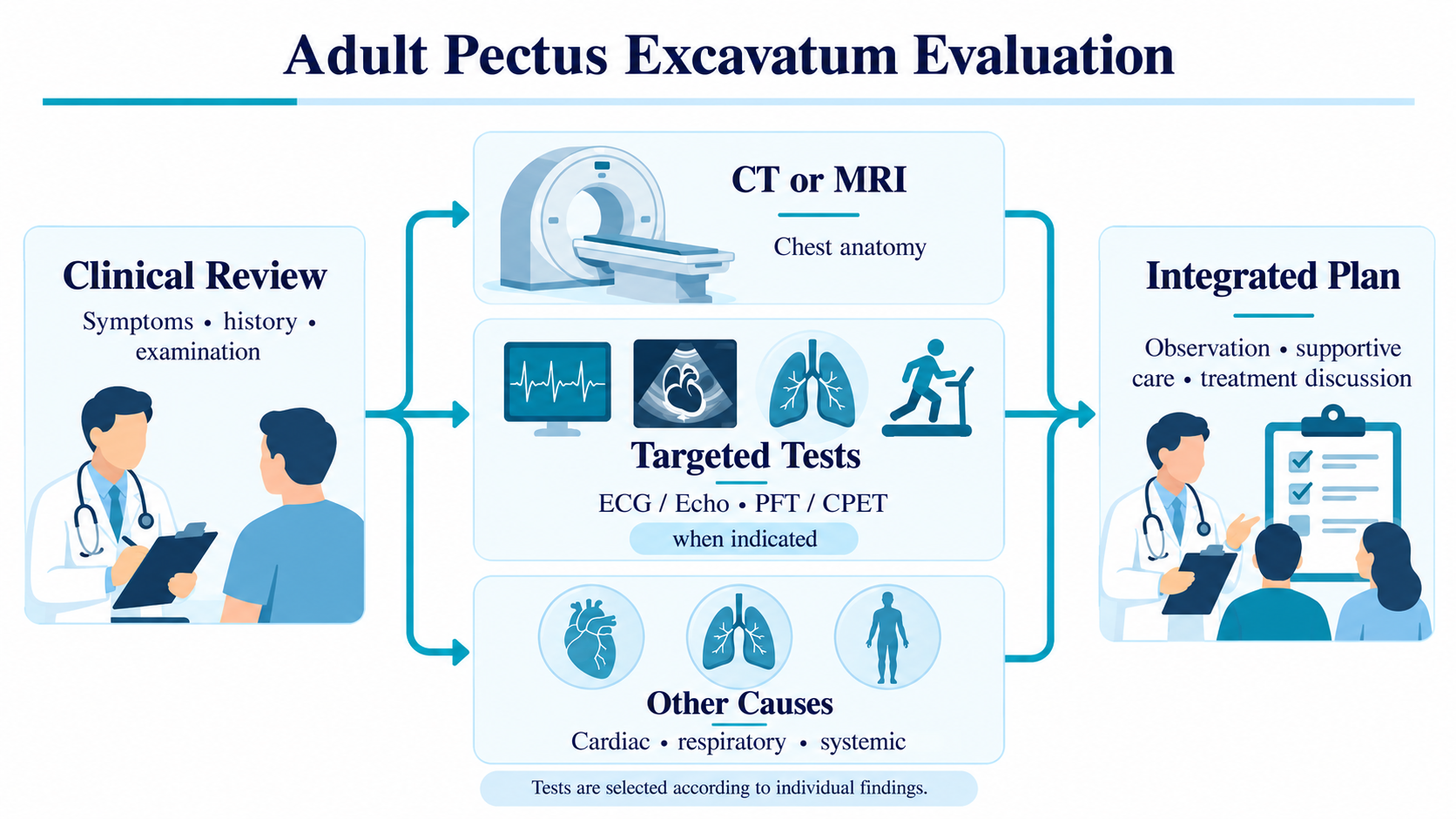
Not every adult with pectus excavatum needs every examination. The tests selected depend on the patient’s symptoms, deformity characteristics, and medical history. Interpreted together, the findings provide the basis for choosing observation, supportive care, or a discussion of corrective treatment.
Learn more about pectus excavatum diagnosis and evaluation.
Can Pectus Excavatum Still Be Treated in Adults?
Yes. Pectus excavatum can still be treated in adulthood. Age alone does not decide whether treatment is appropriate; the plan is guided by symptoms, internal anatomy, objective function, overall health, and the patient's priorities.

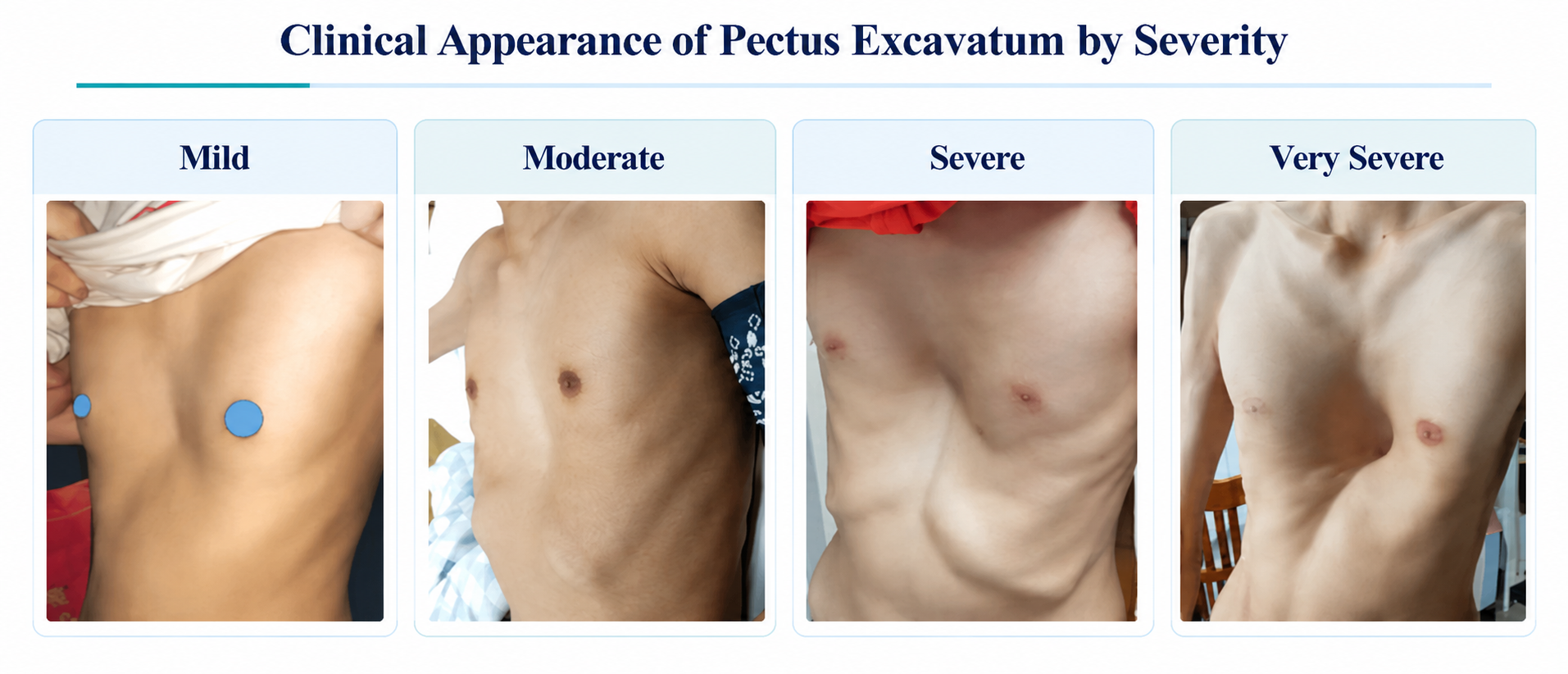 Note: In clinical practice, pectus excavatum severity is commonly assessed using the Haller Index: 2.9–3.2, mild; 3.2–3.5, moderate; 3.5–5.0, severe; and >5.0, very severe. The Wenlin Index may also be used in ICWS: 0–0.33, mild; 0.33–0.67, moderate; 0.67–1.0, severe; and >1.0, very severe.
These indices are only part of the assessment. The severity of pectus excavatum and whether surgery is appropriate depend on the patient’s symptoms, heart and lung function, and other examination findings, not on a single number alone.
Monitoring May Be Enough for Mild Cases
Adults with mild, stable pectus excavatum that causes little or no discomfort may need only periodic follow-up. Exercise can improve posture and physical fitness, but it does not correct an established bony depression. For many adults with a mild condition, monitoring under medical guidance may be sufficient.[2]
Surgery May Be Considered When Pectus Excavatum Affects Daily Life
Surgery may be considered when evaluation identifies substantial anatomical severity, functional limitations, or a substantial impact on quality of life. Factors that may support further surgical evaluation include:
- New, persistent, or progressive symptoms that reduce exercise capacity or interfere with ordinary activities.
- Severe chest depression, particularly when imaging shows cardiac compression or displacement.
- Objective exercise, cardiac, or respiratory findings that demonstrate functional limitation attributable to the deformity.
- A substantial psychosocial effect that continues to impair quality of life.
In adults, chest wall rigidity, bone condition, other health problems, and previous chest or cardiac surgery can affect the complexity, risks and technical planning of corrective surgery.[1,2] These factors are considered together when selecting a treatment plan.
How Does ICWS Plan Pectus Excavatum Surgery for Adults?
At the Institute of Chest Wall Surgery (ICWS), four factors guide the planning of pectus excavatum surgery for adults:
- Deformity anatomy: the depression's position, extent, depth, and symmetry.
- Chest wall flexibility and bone condition: how the chest wall’s rigidity and bone quality may affect correction.
- Cardiopulmonary and general health: imaging and functional findings, together with relevant health conditions.
- Surgical history: previous chest or cardiac surgery or any earlier chest wall treatment.
After skeletal maturity, the chest wall becomes less flexible, which can make correction more demanding. In older adults with pectus excavatum, bones may also become more fragile. These age-related changes are therefore considered when selecting and preparing the surgical approach.
ICWS provides minimally invasive approaches including the Wang procedure and Wung procedure. When an adult has a rigid or complex chest wall, the surgical plan may also include pre-shaping before bar-based correction. Pre-shaping releases localized stress in the deformed area and reduces resistance during the subsequent correction, helping the operation proceed more smoothly.
If you have new or worsening symptoms that affect your daily life, consider seeking a specialist assessment. Our team can review the findings, explain whether surgery may be appropriate, and discuss how the surgical plan can be tailored to your chest wall anatomy and overall health.
FAQ
Can Pectus Excavatum First Appear in Adulthood?
Primary pectus excavatum is congenital and does not begin as a new deformity in adulthood. A mild depression may have been overlooked earlier, or its appearance or functional effects may become more noticeable later. A newly developed depression after surgery or trauma may represent secondary pectus excavatum and should be evaluated separately.
Does Pectus Excavatum Go Away in Adults?
No. Once the chest wall has developed a structural depression, it does not correct itself after skeletal maturity. The course of pectus excavatum with age differs among adults: the visible shape may remain stable for years while symptoms remain absent, emerge, or change over time.
Can Exercise Correct Pectus Excavatum in Adults?
Exercise can support posture, general fitness, and physical conditioning, but it does not correct an established bony depression. A new decline in exercise capacity should be medically assessed before attributing it to fitness alone.
Does Previous Chest Surgery Rule Out Treatment?
No. Previous chest or cardiac surgery changes the assessment because scars, altered ribs, adhesions, and other anatomical changes can affect access and risk. It does not automatically exclude treatment, but it makes an individualized specialist assessment especially important.
References
[1] Aly MR, Farina JM, Botros MM, Jaroszewski DE. Minimally invasive repair of pectus excavatum in adults: a review article of presentation, workup, and surgical treatment. Journal of Thoracic Disease. 2023;15(9):5150-5173. https://jtd.amegroups.org/article/view/76367/html
[2] Dunning J, Burdett C, Child A, et al. The pectus care guidelines: best practice consensus guidelines from the joint specialist societies SCTS/MF/CWIG/BOA/BAPS for the treatment of patients with pectus abnormalities. European Journal of Cardio-Thoracic Surgery. 2024;66(1):ezae166. https://academic.oup.com/ejcts/article/66/1/ezae166/7706289